


The Chinese space station Tiangong, permanently occupied since June 5, 2022, is about to receive a new set of crew members. Shenzhou 23 launched atop a Chang Zheng 2F (CZ-2F) from Site 91 at the Jiuquan Satellite Launch Center in the Inner Mongolia province of northwest China.
Launch took place on Sunday, May 24, at 15:08 UTC. The rocket flew southeast to take Shenzhou 23 and its three crew members to a low-Earth orbit inclined 41.47 degrees to the equator. This matched Tiangong’s orbit for a rendezvous and docking three and an half hours after liftoff.
Shenzhou 23 will dock to a port on the Tianhe core module and join the Shenzhou 22 and Tianzhou 10 spacecraft already docked to the station. The current crew members will conduct a handover period with the new crew before returning to Earth aboard Shenzhou 22.
The Chinese Manned Space Agency (CMSA) has a policy of having a second CZ-2F and Shenzhou spacecraft readied to fly close to any given mission to allow for a launch-on-need mission. This policy had its first operational use during the Shenzhou 20 situation.
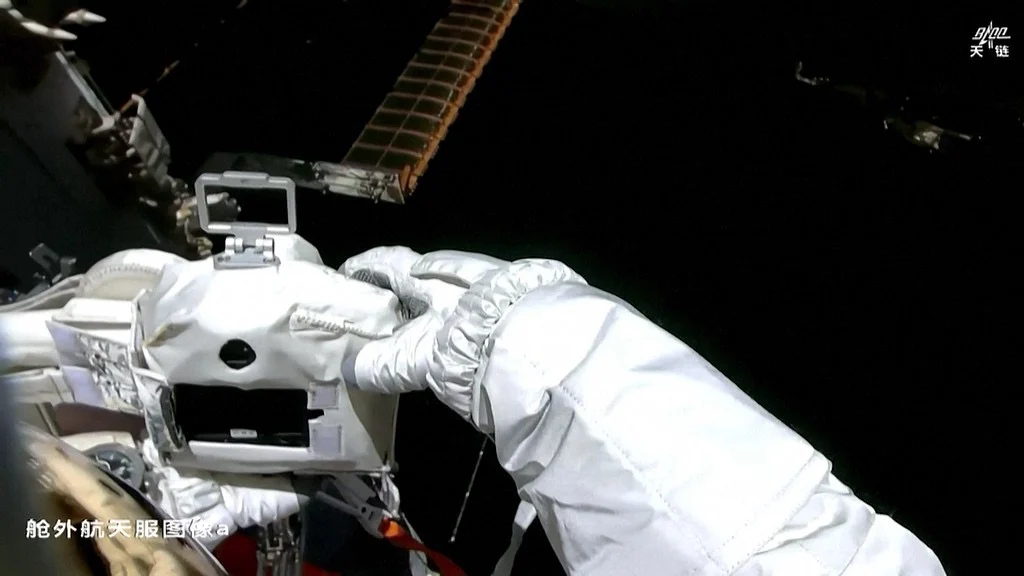
The Shenzhou 20 crew, Chen Dong, Chen Zhongrui, and Wang Jie, landed safely aboard Shenzhou 21 on Nov. 14, 2025, in Inner Mongolia. Tiangong’s remaining occupants, Zhang, Wu, and Zhang, only had the damaged Shenzhou 20 craft for an emergency return to Earth for 11 days.
As things turned out, the Shenzhou 20 crew module safely touched down in the Gobi Desert on Jan. 19, 2026. The outgoing Tiangong crew will land in China using the Shenzhou 22 spacecraft in the coming days after Shenzhou 23’s launch and station handover to the new crew.
CMSA typically names Shenzhou crews just days before launch. Shenzhou 23’s mission commander is Zhu Yangzhu, with taikonauts Zhang Zhiyuan and Li Jiaying (also known as Lai Ka-ying) traveling alongside Yangzhu.
Mission commander Zhu, 39 years of age, was born in Jiangsu province on the Chinese east coast. He is a senior colonel in the People’s Liberation Army (PLA) Ground Force, an engineer, and a veteran of the Shenzhou 16 mission to Tiangong in 2023. He has nearly 154 days in space to his credit, along with extravehicular activity (EVA) experience, and is a member of the third group of Chinese selectees.
Mission pilot Zhang, also 39, is a colonel in the PLA Air Force and a member of the Chinese Group 3 of taikonauts as well. Shenzhou 23 will be his first flight into space. Payload specialist Li, 43 years of age, is the first Chinese astronaut from Hong Kong to fly. Shenzhou 23 will serve as her first spaceflight.
Li, formerly an inspector with the Hong Kong police, also holds a doctorate in information science and computing. She was selected as part of the fourth Chinese taikonaut group. China recently opened its taikonaut selection process to residents of the Hong Kong and Macau special administrative regions.

Two crew members will stay aboard Tiangong for a roughly six month tour of duty similar to other crews, while another will remain on the station for roughly one year. This would set a new Chinese space endurance record, and the taikonaut who sets this record will return aboard Shenzhou 24. This astronaut has not yet been identified, but will be chosen later based on health.
The Shenzhou 23 crew will conduct experiments and research in human health in space along with experiments with human stem cell-derived artificial cells and embryos from zebrafish and mice. They will test experimental lunar fibers, mount a greenhouse gas monitor on the outside of the station, and conduct many other experiments in various fields and maintenance activities, including spacewalks.
This flight was the second launch of the CZ-2F rocket in 2026, following the launch of an experimental spaceplane on Feb. 7. Shenzhou 23 was also the third orbital and fourth overall crew launch of this year, with the others being the NS-38 suborbital flight, the Crew-12 mission to the International Space Station, and the Artemis II crewed lunar flyby.
The Shenzhou spacecraft and CZ-2F first flew in 1999, and the first crewed Shenzhou flight took place in October 2003 with Yang Liwei becoming the first Chinese person in space to fly on a Chinese-built vehicle. CMSA is currently developing the Mengzhou spacecraft to succeed Shenzhou, which is expected to later fly crews to the Moon.
Mengzhou 1, the first uncrewed test flight of the Mengzhou capsule, is scheduled to fly sometime later this year atop a Chang Zheng 10A. One version of Mengzhou will succeed the Shenzhou for flights to Tiangong, while another version will fly astronauts on lunar landing missions with the Lanyue lander.
Assuming things proceed normally, Shenzhou 24 is scheduled to fly sometime this fall, possibly in October. It will fly with a Pakistani payload specialist on the crew for a week in space and a return aboard Shenzhou 23.
(Lead image: Shenzhou-23 launches from Jiuquan on May 24, 2026. Credit: CGTN)
This content is shared for information & learning purpose only,All rights belong to original author.Contact us to remove content if needed.
